Tuesday, January 22, 2013

Post SIT Travels: Bangkok, Thailand

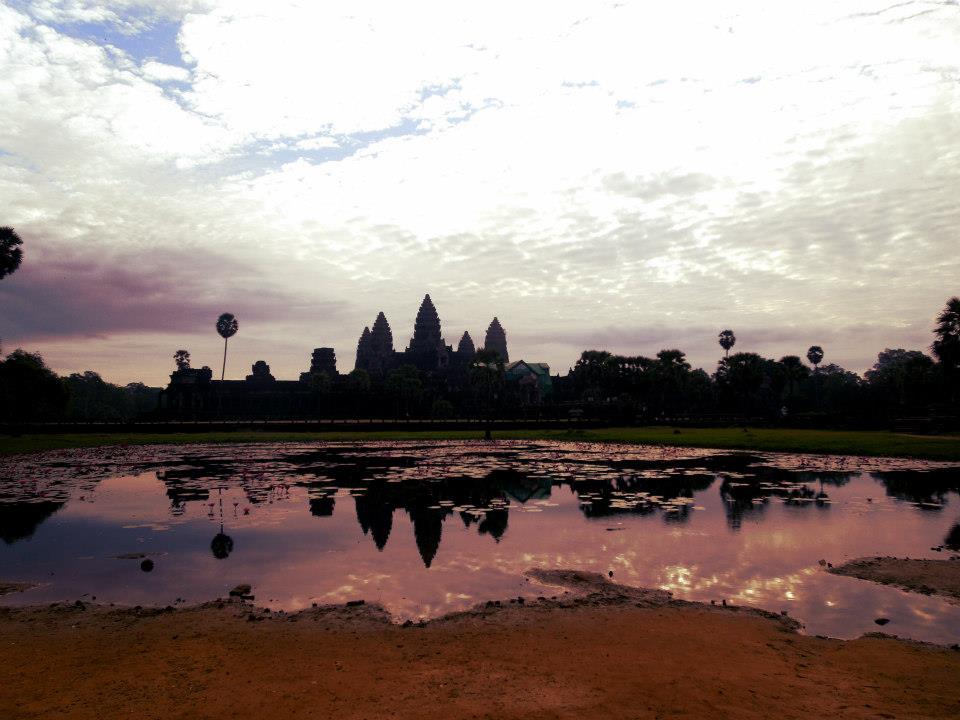
After seeing the magnificent sunset at Angkor we finished the night by shopping at the night market and  having Chinese food for dinner.  The next morning we took a bus from Siem Reap to Bangkok for $15.  Now my uncle had warned me about the buses from Cambodia to Thailand saying to be really prepared for the bad roads and bad service.  Looking back, I should have listened to his advice.  

The first part of the trip went okay.  We started out at 6:20 a.m., twenty minutes later than planned, and an eighties karaoke video was playing for the first half hour (luckily the video player soon broke).  After we arrived at the border everyone on the bus was given a small red sticker.  We had given them our tickets so that was all we had to prove we were on the bus.  People started unloading our bags and I grabbed mine right away.  Some boys were putting bags onto a trolley and when my friend tried to take hers off they said something in Cambodian, shaking their heads.  "But that's my bag!" she said and took it off anyway looking confused at them.  I do not know where her bag would have ended up if she had not taken it.  Everyone on the bus lined up at the customs office leaving Cambodia.  We were all fingerprinted again to make sure our arrival and departure prints matched.  Once we made it out of Cambodia we still had to walk about 300 meters along a road where there was a casino before we arrived at the customs office in Thailand.  Entering customs in Thailand there was a huge sign written in English and Thai that said "Transportation of Drugs Punished by Death".

We filled out immigration cards and obtained our free 15 day tourist visas.  (If you arrive by air, you get a free 30 day tourist visa.)  After exiting the building my friends and I were told by a woman, "You have red sticker? Keep walking".   About 100 meters further along the road, where trucks filled with goods were driving by, we arrived at a pickup truck with seats in the truck bed.  They luckily saw our red sticker and instructed us to get in the truck while we waited for the rest of our group.  Once the truck was full we were driven to a small rest stop area where we thought we would meet up with our coach bus.  We were very wrong.  After 45 minutes of waiting, we were told to go into a very small van, that we somehow fit fifteen people into.  "Okay 4 hours to Bangkok", the driver said and everyone squished in the hot van looked shocked since it was already close to the time that we should have been arriving.  Maybe it could theoretically take four hours, but every hour we had to stop at a gas station and wait in a long line of cars to refuel.  Finally, we made it to Bangkok, much later in the afternoon than we had anticipated.  Moral of the story, you can't buy time so maybe consider flying if you only have a few days to travel.

We went directly to our hostel, Lub D, which was an amazing place.  It was very clean and had a very artsy/modern feel to it.  We were lucky because the dorm rooms we had booked were filled so we got two double rooms for the night for no extra charge.  Since we were in Thailand, we went to find pad thai for dinner and it did not disappoint!

First pad thai in Bangkok. Thanks again to Anna for letting me use her photos.
We explored the night market in Bangkok and went on a hunt for mango sticky rice.  For those of you who have never tried mango sticky rice, let me explain.  First, sticky rice is a different type of rice than say jasmine rice.  Sticky rice has to be soaked for several hours then drained and steamed to obtain the perfect texture.  Each grain of rice should still hold it's shape so it should not be mushy, but when properly made the grains still stick together.  After the rice is steamed, coconut milk is poured over and it's left to soak in.  To serve, you put a mound of the coconut sticky rice on a plate, slice a ripe mango, place it over the rice, and top it with more coconut milk and crispy mung beans.  It's one of my top favorite desserts (it might even beat Magnolia's banana pudding and that's saying something!).  After asking over ten people in English and broken Thai we finally found a street vendor who sold it.  It was well worth the hunt! 


Mango Sticky Rice
 Since we had spent most of the previous day on a small, hot bus, we decided to spend the day in Bangkok and fly to Chiang Mai, a city in Northern Thailand, later in the evening.  Previously, we were going to take a train, but we could not bear the thought of being on a train for ten hours instead of an hour and a half flight.  We had almost the entire day in Bangkok until our flight left so we decided to sleep in and explore Chinatown.


 Bangkok is a huge city so we had a taxi drop us off on a street in the heart of Chinatown.  Chinatown was mobbed with people selling steaming food and bright juice, bartering in cramped stores, cooking on the street, and buying everything imaginable.  We found a dim sum restaurant and ordered a large assortment that included pork and shrimp dumplings.  The restaurant we ate at, and many others in the area, also sold shark fin soup and birds nest soup, which are controversial dishes in the U.S.

Dim sum

We also had black bean steamed buns, bbq pork steamed buns, and (my absolute favorite) egg custard steamed buns.  In Vietnam, banh bao, a steamed bun filled with different meat, vegetables, or eggs, was one of my favorite snacks.  After eating we walked through an indoor market and the surrounding streets.  I could have spent all day going through the spices, identifying the vegetables, and trying the fruits.  Instantly I fell in love with all the foreign smells, the bustling people, and all of the food.  I am convinced you could buy any ingredient imaginable there.  They even sold sea cucumbers!

Hanging pork belly and crispy duck. 
Grilled and fried bananas.  
A big dried fish. 
Spices, flowers for tea, dried berries. 

Sea cucumbers
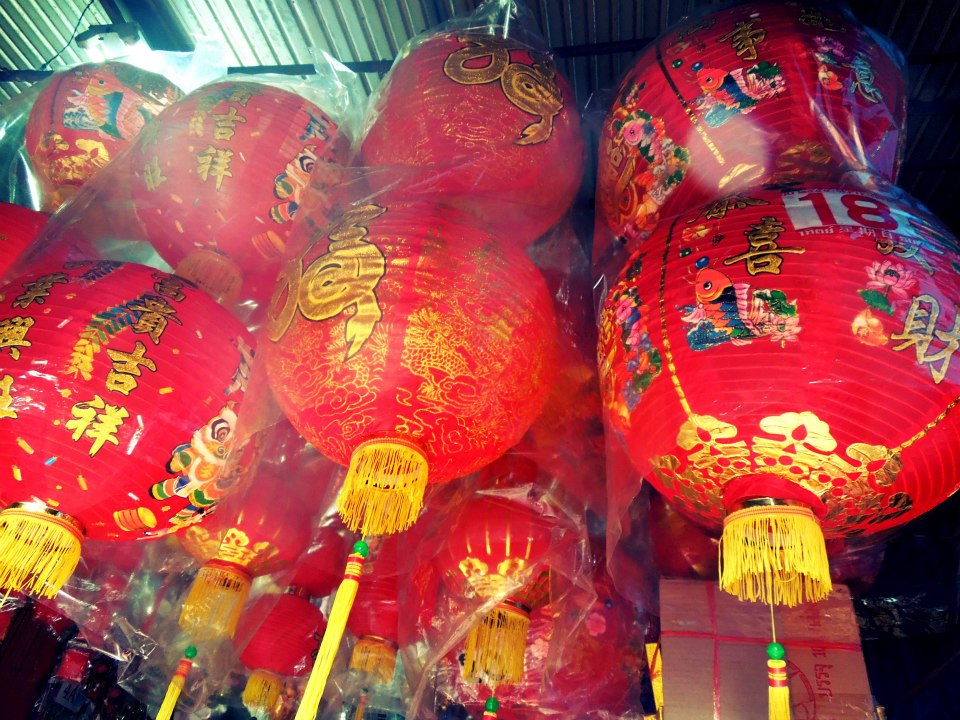
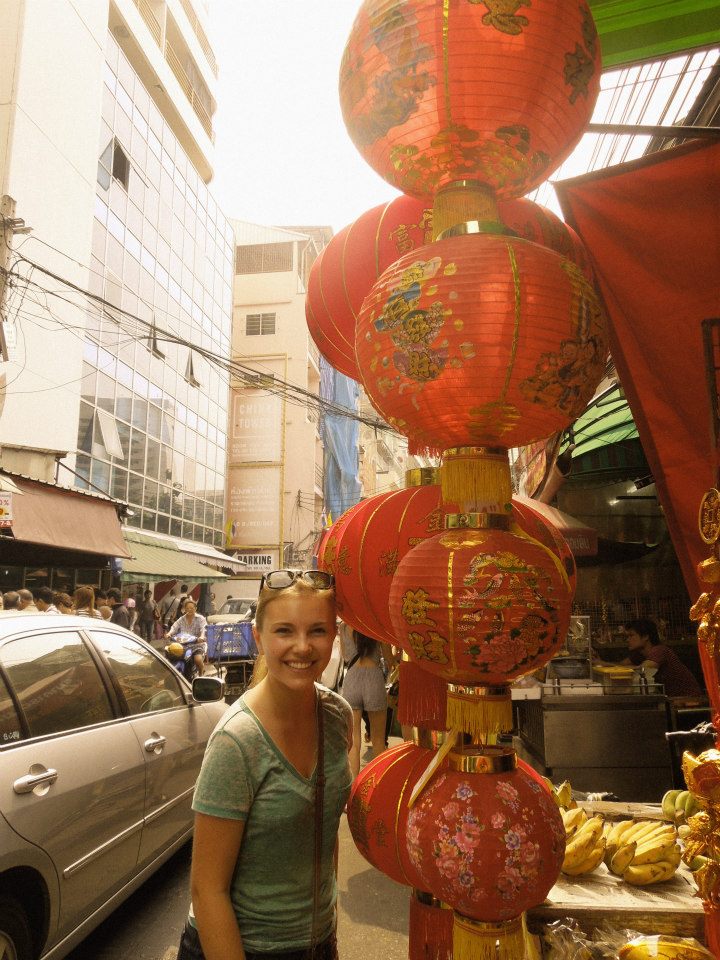
Chinese lanterns.
While walking around, we came across this woman who was making what appeared to be mini taco-like treats.  She spread a thin layer of batter in an oval shape over a heated griddle.  Then she put a dollop of what appeared to be creme fraiche.  Half were topped with a stringy yellow substance that I recognized as a version of fios de ovos that is used in Portuguese desserts.  It kind of looks like cooked spaghetti squash and is made with egg yolks and sugar.  I found another food blog that discusses how it's made and the countries it's made in, Thailand included! You can read that here, http://www.oohmummy.com/2010/04/i-wanna-eat-keiran-somen.html. The other half of the ovals were topped with a sticky orange substance.  Both varieties were piled into a small plastic bag and sprinkled with sesame seeds and green onions.  The "tacos" were bite sized and packed a punch.  We think the orange substance was made of dried fish or shrimp, but it was still surprisingly sweet and had a kick of chili at the end.  It actually paired really well with the green onions creating a perfect bite of food.  

Add caption

Larger versions of the "tacos". 
 On each street there was also at least one person selling freshly squeezed orange juice and pomegranate juice.
The most perfect pomegranates. 
Decorated paper that families buy to burn during the New Year. 


Purple yucca
Colored steamed buns. Don't they look like Easter eggs? 
Bangkok
After our exciting day in Chinatown, we packed a small bag and headed to the airport to fly to Chiang Mai in Northern Thailand. 

Monday, January 21, 2013

Post SIT Travels: Cambodia

I know it has been over a month since my last blog post and I apologize.  My program ended on December 11 and then from December 12 to December 20 I traveled throughout Cambodia and Thailand with three other students on my program.  I returned to Vietnam and spent two nights with my host family in Ho Chi Minh City before departing to NY.  It was a lot of traveling, but I was use to it after already living out of a suitcase since the end of August.  My adventures in Cambodia are below and the rest will follow shortly.

 After a couple rounds of tear jerking goodbyes to some of the students on the program who were leaving to fly to different countries, I was off to start my own post-SIT adventure.  (After the program ended, the eleven students on my trip were in seven different countries: Vietnam, Cambodia, Malaysia, U.S., England, Israel, and Thailand.)  I met up with three other women who were on my program and we boarded the Mekong Express bus at 8:30 a.m. to travel to Phnom Penh, the capital of Cambodia. The coach bus was actually really nice.  It had air conditioning ( a must since it was about 90 degrees outside), there was a Jackie Chan movie playing, and we got some pastries for breakfast.  It cost around $11.  Once we arrived at the Cambodian border we had to get visas.  When entering and exiting Cambodia, people are fingerprinted by an electronic pad.  Some people had obtained their visa's online (it cost $20), but I did not so I had to pay $25 at the border for my visa.  After passing customs, a man holding passports asked for mine.  Once all my friends got through, I panicked that I had given my passport to a random person when I saw that they had their visas with them.  After picturing myself stranded on the border without my passport, I realized that it was because they needed to put my Cambodian visa in the passport.  (My friends had gotten the e-visa online.) We stopped for lunch and arrived in Phnom Penh in the late afternoon. 

*A quick note about the pictures to follow in Cambodia and Thailand... My camera was stolen in Vietnam right before I left on my trip, but it was my fault.  Vietnam is a very safe country.  Civilians are not allowed to own firearms (I read that shotguns are excluded, but I'm not positive), handguns, or assault weapons.  When I was in Vietnam, I was never afraid for my safety at any point (well maybe at the beginning while trying to cross the street, but I soon got the hang of that).  As a young woman, I was not afraid to walk by myself or take public transportation alone.  I never saw any violent crimes, but petty crimes were rampant, especially in the big cities.  iPhones, laptops, and apple products in general were targeted.  I once saw a woman talking on her iphone on the side of the street then heard her yell as a motorbike driver zoomed away clutching her phone.  When my camera was stolen I was out dancing and I think I forgot to zip my purse, which I had moved behind me to dance.  The next thing I knew my camera was gone, but at least no one was hurt, and really it was only a camera.  So I must give a big THANK YOU to Anna for letting me use the photos on my blog that she took during our trip to Cambodia and Thailand! 

Jenny and I in the tuk tuk that took us to our hostel, The Mad Monkey.  The covered seating area was attached to a motorbike. 
We only had one night in Phnom Penh so we decided to go to the Tuol Sleng Genocide Museum.  Each of us had very little knowledge of Cambodia's history.  We had heard of Pol Pot and the Khmer Rouge, but that was all we knew.  The Genocide Museum was very eye opening.  The museum was in a former high school that had been used by the Khmer Rouge for the Security Prison 21 from 1975-1979.

A classroom used for torture in Security Prison 21.

An estimated 17,000 people went through the prison.  Once they were brought there, prisoners were interrogated.  After they admitted the crimes they were charged with (however false the accusations were) prisoners were executed.  There were rooms upon rooms filled with black and white photos of prisoners that were all photographed upon their entry into the prison.  The photos were very powerful.  Some of the people stared back at the camera in defiance, others looked into the distance, and some looked defeated.  Only 7 people are known to have survived the prison.  

After visiting the prison, we decided to walk around the city and have dinner.  Cambodian food, like Vietnamese food, focuses on balancing flavors, using seasonally appropriate ingredients, and the presentation of the dishes.  Amok is a typical Cambodian dish that is usually prepared with fish, spices, coconut milk, egg, and peanuts that is steamed in a banana leaf.  Lok Lak is also popular.  It consists of stir-fried, cubed beef served with onions, tomatoes, lettuce, and a rich brown sauce.

Phnom Penh at night. 

On the morning of December 13, we left Phnom Penh and bordered another Mekong Express bus to travel to Siem Reap.  A friend of our last tuk tuk driver met us at the bus stop and dropped us off at the Siem Reap hostel, which only cost us $6 per night.  We explored the night market and Pub Street, which is a street with lots of restaurants.

Pub Street

The morning of December 14, we woke up at 4:30 a.m. to meet our tuk tuk driver who drove us to Angkor, the largest Hindu temple complex in the world, to see the sunrise.  Before we entered the World Heritage Center we had to purchase a $20 one day pass that allowed us to enter the site multiple times throughout the day.  Once we received entry, our driver took us outside perhaps the most famous temple, Angkor Wat.  It was still pitch black when we arrived and I was glad that the other tourists that surrounded us walking towards the temple had thought to bring flashlights.  The sky started to get lighter around 5:30 a.m. and the sun completely rose around 6:20 a.m.

Sunrise over Angkor Wat. 

Sunrise over Angkor Wat. 

Sunrise over Angkor Wat. 

After the sunrise, we walked around Angkor Wat temple and explored the brilliant architecture and carvings.  Construction on Angkor Wat started around the 12th century.  Some of the scenes depicted battles with people riding elephants carrying swords and shields.  We ate some noodles for breakfast near the temple and went to find our tuk tuk driver.  The Angkor World Heritage site is made up of more than 1,000 temples, though many are in ruins. We spent the rest of the morning driving around to the large temples that are still standing and walking throughout the buildings and the surrounding area.


Notice the face carved on the left of the tall column.


There were reconstruction projects occurring at many of the temples. 


The temples were HUGE! Our tuk tuk driver would drop us off in front of the temples and leave us to explore.  We went through about six and were exhausted by the end.  They would seem small, then there would be a lot of doorways that led into new bigger sections with more exits into different sections.  We also were able to see the temple where the film Tomb Raider with Angelina Jolie was filmed.
Photo courtesy of Sarah.

In the tuk tuk.  Photo courtesy of Sarah.
The four travelers.
An impressive tree over a temple door. 
Photo courtesy of Sarah.
After walking through the temples, we went back to our hostel to go on a food tour of the local market. Remember how I said I will eat anything?  Well if you're eating now, finish your meal before you continue.  The first place our guide took us to was a stand that sold fruit, vegetables and bugs.  Now I had seen fried bugs before and swore I would never try them.  But, it's an experience, right?  So, I tried a wide variety just to say I did it.  

Fried frogs.  Fried snakes are in the upper left corner. 
Fried crickets. 
Fried grasshoppers and big black beetles.
Most of the bugs like the grasshoppers and crickets tasted like grease, as did the fried frogs and fried snakes.  Our guide told us that they were caught in the rice paddies, so I guess they're fresh...?  They were not as bad as I was expecting until I tried the big black beetle.  As you can see from the before and after pictures below, it was not good.  Actually, it was probably one of the worst things I have eaten in my entire life since it tasted exactly how cow poop smells.  I somehow managed to swallow and almost begged for some of the fried snake to get the taste out of my mouth. 

Before eating the black beetle

After eating the black beetle.  I'm in the upper right hand corner.

After the bugs, we moved on to try really delicious crab, meatballs, and vegetables and an indoor market stand.  


 We finished that off with dessert. It was similar to Vietnamese "che" where you could choose your own combination of beans, sticky rice, pudding, coconut milk, tapioca, banana, and ice to make your dessert.

Dessert 
Leftovers anyone? 
We rested after the food tour and took the tuk tuk back to Angkor to see the sunset at 5:30 p.m.  We hiked up a small mountain to reach a temple we had not yet been to that provided an excellent view of the setting sun.  There were hundreds of tourists and the view was spectacular.

Walking up to the top of the temple.  Photo courtesy of Sarah.
Photo courtesy of Sarah.

Photo courtesy of Sarah.

Our group with our Norwegian friend that we met at our hostel.

Notice the hot air balloon to the left. 

Monday, December 10, 2012

Happy Holidays!

It is my last day in Ho Chi Minh City before traveling to Cambodia and Thailand.  In the past week, HCMC has been covered with holiday decorations that almost rival the decorations in NYC.  It is strange to see all these decorations when it's 90 degrees outside, but it makes me excited to get home and celebrate with my family.  Last week Tom, Libie, and I attended a hotel holiday party, complete with cookies, wine, and caroling.  Wherever you are, Happy Holidays!

Photos courtesy of Libie.


Sunday, December 9, 2012

ISP Presentations - The End is Near

Tomorrow is the very last day of my program.  I cannot believe how fast it has gone by.  On December 7, my entire class reunited in Ho Chi Minh City at the guest house we had stayed at during our first two weeks in Vietnam.  The last time we were at the guest house we were just getting to know each other, figuring out how to cross the streets successfully, and adjusting to life in Vietnam.  The guest house hadn't changed a bit, but each of us are a little different than when we first arrived.  Not only are our chopstick skills impeccable, but we have learned how to live for a month on our own in a different country.  I have met a very diverse group of people: Vietnamese students, backpackers from the UK and New Zealand, farmers in the Mekong River Delta, ethnic minority groups in Sapa, chefs in Hue, professors from around the country, and of course the students on my program.  Every person I have met around Vietnam has given me insight into different aspects of Vietnamese culture and American culture as well.

On December, 8 my class went back to the University of Economics to present our ISPs.  Each student gave a twenty-thirty minute powerpoint presentation about their project.  Vietnamese students, university professors, people we had met throughout the semester, some host families, and a group of around eight representatives from SIT came to see our presentations.  The SIT representatives each worked in different regions around the U.S.  Each year they go to one program to see how it is run and what types of projects the students are able to do so they can better promote it at different colleges. 


All of the studies were very unique.  Ethan presented about the success rate of an NGO called "Village of Hope" that provides vocational training to underprivileged students.  Tom discussed sustainable tourism in Hue, Hoi An, and Da Nang.  Eliza studied the sources from which Hue high school students derive their knowledge about sex.  Anna studied diabetes in Vietnam and was able to assist many doctors with their research.  Libie studied the autism and talked with parents about the diagnostic process in Vietnam.  Sarah learned about the organic farming movement in Hanoi.  Nancy talked about how Vietnamese that live overseas are treated differently than Vietnamese living in Vietnam.  Jenny spoke about the difficulties Vietnamese university students have in finding a job after school.  Molly presented about the influence of fortune telling in the lives of Vietnamese people. Instead of presenting a powerpoint, Ben played a forty minute video he had made about Zen Buddhism.  For his ISP, he spent the month living with Buddhist monks in a monastery in Da Lat.  My project was called, "Effects of Tourism and Globalization on the Commercialization of Hue Royal Cuisine".


Back row: Ben, Sarah, Tom, Eliza, Ethan
Front Row: Jenny, Molly, Nancy, Me, Libie, Anna
Photo Courtesy of Libie 


The whole class with our academic director, Co Thanh, and assistant director, Vy on the left.

 It is strange to think that after spending 24/7 with a group of people that we will soon be leaving each other to go back home.  The majority of our group is going to keep traveling around different countries in Asia and then make it back to the U.S. by Christmas.  I am going to travel with Sarah, Jenny, and Anna to Angkor Wat in Cambodia and Bangkok and Chiang Mai in Thailand then come back to Ho Chi Minh City for a few days.


I really could not be happier that I chose SIT Vietnam.  Through most study abroad programs students say in one place. They may have the opportunity to read about the different geographical landscapes of the country they are visiting, hear stories about the people, or see photos of different foods, but nothing can beat 
experiencing all this first-hand.

Ancient Hue Restaurant and Gallery

During my ISP, I was lucky enough to be able to spend time at Ancient Hue Restaurant and Gallery.  The restaurant was built in 2005 to showcase the royal cuisine.  The owner of Ancient Hue also wanted a place to preserve and display traditional Hue art and architecture so traditional wooden houses were constructed next to the restaurant.  Chefs at Ancient Hue use modern cooking techniques, like gas stoves, and a variety of ingredients to prepare their version of the royal cuisine for customers.  They also incorporate traditional aspects of the royal cuisine such as decorative carvings to preserve the food’s royal appearance.

 Tuyet - Ancient Hue Carver
It is 11:00 a.m. and two chefs are busy in the kitchen slicing squares of pale yellow homemade bean curd, which is on today’s menu.  One woman is sitting alone at a metal table off to the side of the kitchen, surrounded by an assortment of small knives and root vegetables.  Below the table is a bowl filled with three orange goldfish, carved from a pumpkin, that look like they are swimming.  This woman is the carver.  Tuyet is one of two chefs at Ancient Hue that specializes in carving decorations to adorn the plates of guests. 
Three years ago, when she was 21 years old, Tuyet learned how to carve from another chef at Ancient Hue Restaurant.  She occasionally still uses reference books like, The Complete Practical Book of Fruit Art Carving, which gives instructions on how to carve different fruits, but mostly does everything from memory.  Each dish has a specific plating element and the name of the dish often corresponds with the decoration attached, like phoenix salad.  The majority of tour groups and customers order from pre-set menus so the chefs and carvers know exactly what to prepare for the day.  Many of the dishes feature the same basic decorations, like flowers carved from carrots, so they can be reused on dishes later in the day.  The decorations are meant to be viewed, not eaten, and are almost all disposed of the same day they are created.
In front of Tuyet is a white turnip carved in the shape of the head of a bird.  The beak is crafted from an orange carrot and black peppercorns adorn the eyes.  Tuyet works quickly, switching tools to carve feathers down the phoenix’s neck.  Each day she works eight-hour shifts, carving the entire time.  In one day she usually makes twenty small and two big carvings.  The large carvings, like the phoenix, can take around one and a half hours.  She uses white turnips, carrots, melons, green papayas, pumpkins, tomatoes, and cucumbers to carve animals like dragons, crabs, fish, shrimp, and swans.  She also carves flowers and famous architecture from Hue like bridges, pagodas, and dragon boats.  
At the end of each customer’s meal, Tuyet goes to the guests’ table with a carrot, turnip, and some small knives.  She starts by carving the carrot while the guests try to guess what it will be.  In a matter of seconds an orange prawn appears.  She then demonstrates how to make a rose out of the turnip to the delight of the customers who “ooo” and “ahhhh”, taking out their cameras to record the food art. 
 Tham - Ancient Hue Head Chef
Tham was twelve years old when she became interested in cooking.  She learned how to prepare some Hue traditional recipes, like bun bo Hue (beef noodle soup) from her mother.  Tham was born in Hue, but completed a three-year cooking course in Hanoi after finishing high school.  Now at age 47, she has worked for a total of 27 years in the restaurant industry.  When I interviewed her, she was in her third month at Ancient Hue Restaurant.
As head chef, she decides what will be on the menu and how it is plated.  In the past, the menu was more dependent upon the season since chefs had to grow their own ingredients.  She remarked that with the presence of supermarkets and outdoor markets it is much more convenient to purchase out-of-season ingredients.  Also, it is easier to buy imported ingredients, like alcohol and cheese.  She said tourism has made the royal cuisine more famous, though it is not exactly the same as it was during the time of the Nguyen Dynasty, which can be attributed to the variety of ingredients that were not available during the emperors’ reign.  Recently available products such as chicken powder and MSG enhance and add a different flavor to the royal cuisine dishes that could not have been achieved before. 
To plate each dish, she considers the meaning of each dish and how to symbolize the stories on the plate.  The phoenix and dragon represent the queen and king respectively and are a typical garnish used to distinguish the royal cuisine from common food. 
Huong - Ancient Hue Assistant Chef
 Huong sits at a small table outside the kitchen peeling a large bowl of shallots.  She has worked for 12 years in the culinary field after her initial career as a photographer.  She did not go to university, but learned all her cooking knowledge from working in restaurants.  Cooking at Ancient Hue, Huong remarked that the menu is catered to tourists.  The chefs use of ingredients distinguishes the tourist food from the dishes cooked for local Hue people.  Even though the chefs are preparing royal cuisine the food is still cooked with less chili and spice at the restaurant than what they would cook if they were home.  When cooking, Huong looks at recipes for the list of ingredients, but estimates and tastes the dish to decide on the correct proportions.
 Inside the Dining Room
  The entire experience that customers have at Ancient Hue is meant to transport them back to the time of the Nguyen Dynasty, with modern conveniences to make customers more comfortable.  The waitresses wear red and gold ao dai’s, the traditional Vietnamese dress, which symbolize the colors of the royal family.  Each dining room is adorned with plush upholstered chairs and hand crafted wooden tables.  The air conditioner is on high as easy listening music plays in the background.  Each customer who orders from the fixed menu is presented with a paper menu, outlining the order of the dishes written in Vietnamese and English.  In the large a la carte menu, the menu prices are written in U.S. dollars, catering to tourists.  The restaurant also accepts payment by U.S. dollars, Vietnamese dong, and the Euro. 

       The fixed menu lists seven dishes: three appetizers, one main dish, two side dishes, and a dessert.  On November 21, the menu included vegetable soup, deep fried bean curd, rice paper rolls with grilled pork, royal stewed red snapper in ginger sauce, sauteed bok choy with oyster sauce, steamed rice, and sweet taro mousse with coconut ice cream. The fried bean curd was plated with a carving of a vase of flowers, the rice paper rolls had a carrot flower, and the red snapper was served with a fish carved from pumpkin on a piece of ginger.  The waitresses cleared the plates after each course and swiftly replaced them with the next dish. 
Fried Bean Curd
None of the dishes were very spicy or over seasoned.  Instead, each of the ingredients were balanced so that they complemented and enhanced the flavor of the entire dish.  The fried bean curd had a crispy breading surrounding the silky smooth filling.  It was paired with a tangy dipping sauce to offset the mellow flavor of the bean curd.   The ginger sauce added a peppery, sweet taste to the red snapper.  The bok choy added a contrasting crisp texture to that of the soft fish and the fresh flavor prevented the ginger sauce from overwhelming the dish.  For dessert, the taro mousse had a texture similar to pudding.  The taro mousse was bitter, but the scoop of cold coconut ice cream on top added just the right amount of sweetness to balance the dessert’s flavors.  During the meal, the front of house manager came around to make sure everything was going smoothly and at the end Tuyet came to demonstrate her carving skills.  It was a meal fit for an emperor. 

Becoming a Celebrity During ISP - Almost

Becoming a celebrity in Vietnam is goal that my friends and I have been joking about accomplishing since our arrival.  We all stick out as foreigners and Vietnamese people are really interested, and not shy, about coming up to us, asking about the U.S. and asking to take a photo.  Back when Eliza and I did our dance routine with members of the English Club from Hoa Sen University (that feels like a very long time ago), we experienced what it must feel like to be a celebrity when we were bombarded by students asking to take photos with us.  We kidded that we were all over facebook in Vietnam.  A week later, my friends and I were walking to dinner when we came upon a film crew and a group of dancers in a park.  We asked around and figured out they were filming a commercial for some milk or yogurt product and dancing Gangnam Style. Long story short, we asked if we could be in it and took our places in the middle.  They filmed us once (I think just to get us to leave).  I'm pretty sure they didn't use that take, but we laughed about how funny it would be if we ended up on Vietnamese TV.  Ironically, it actually ended up happening.

During the second week when I was in Hue, my ISP advisor, Ms. Huy, told me to come to her home on Sunday.  She told me we would be filmed cooking together for an upcoming TV documentary about her career as a chef and how she is preserving the Hue traditional cuisine.  Ms. Huy use to be a teacher, but then decided to come back to Hue and pursue a career in cooking.  She has trained in France and is an honor member of the French National Academy of Cuisine.  She's an incredible woman and currently has three full-time jobs: teaching culinary school students, cooking, and writing books and poems.  Ms. Huy also is a judge for important cooking competitions.

The day of the filming I really did not know what to expect.  I took a cab from my hotel and arrived at Ms. Huy's door at 8:00 a.m.  The film crew, consisting of two camera men and one woman, who conducted the interviews, arrived around 8:15.  First, they filmed Ms. Huy and I walking through the outdoor market near  her house.  She talked about the products, describing where they came from and what they could be used to make.  We bought some ingredients like carrots, green figs, and ground pork and walked back to her house to prepare two dishes: warm fig salad and spring rolls.

Around this time, some of her culinary students, who were all in their early to mid twenties, started arriving.    It was clear that they regarded Ms. Huy as a culinary god.  One of the students told me that Ms. Huy was their idol and that they really enjoyed learning from her.  The students helped us chop the vegetables and prepare the dishes.  To make the fig salad, the green figs first had to be boiled and then peeled.  The figs here do not really resemble the ones sold in the US.  In Vietnam, they are bigger and have less seeds.  Once boiled, they have a grayish color and almost remind me of an artichoke heart.  The figs were then chopped and cooked with sesame seeds, shallots, and a little bit of oil over the stove.

Once the fig dish was moved to a serving bowl and garnished with a bright red flower-shaped chili, we started to make spring rolls.  The ground pork was mixed with sliced carrots, turnips, garlic, cut up glass noodles, green onions, shallots, chili, sugar, salt, pepper, and a few other spices.  Ms. Huy then showed me how to use mung bean paper to wrap the spring rolls.  After they were wrapped, we fried the spring rolls two times; the first time to cook the meat and the second time to brown the outside.


The TV crew filmed the cooking demonstration then asked me to answer a few questions about what I thought of Hue food and Ms. Huy.  After the interview, the crew drove Ms. Huy and I to a park near the Perfume River where we were instructed to walk around arm and arm and engage in conversation.  I really wonder what all the people in the park were thinking when they saw Ms. Huy strolling along with a very blond foreigner trailed by a film crew.  When they got a sufficient amount of footage, the crew drove us back to her home where they interviewed some of her students before packing up their equipment.

Ms. Huy, her students, and me.

Back at Ms. Huy's we finally got to eat the food we had prepared with her students, which was delicious.

Here is the documentary video clip about Ms. Huy, which aired on November 28 in Vietnam.  http://vtvhue.vn/chuyen-muc/hue-tinh-yeu-cua-toi/201211/Hue-tinh-yeu-cua-toi-ngay-28112012-154613 / I'm interviewed around the six minute mark.  I'm dubbed over in Vietnamese, but I'm saying something like, "I love Hue food.  It is really different from food where I am from in New York.  In Hue, all of the ingredients are fresh and the chefs focus a lot on taste, flavor, and texture of the dishes. Ms. Huy is a very accomplished chef and I am honored to be able to learn from her."  I hope this makes you laugh : )